
Best Skincare Products for Women Over 40: What Works, What’s Hype
Key Takeaways
- The real decision is not which brand but which route: actives-led, built around a retinoid, or barrier-led, built around peptides and lipids.
- Retinoids have the longer and more convincing track record. Peptides have the better safety and comfort record on midlife skin.
- Daily sun protection and a proper moisturizer outperform any serum in the cabinet. Everything else is optimisation.
- Give any product two to three months before judging it. Almost every abandoned routine was abandoned too early.
- Where you live changes the answer — humidity, UV intensity, and which sunscreen filters are legally sold in your country all shift what “best” means.
Here is the pattern I see again and again. A woman turns forty-one, notices her jawline softening and her cheeks looking dull by 4pm, and responds the way the internet trains her to: she buys the strongest formula she can find. A high-percentage retinol. An acid toner. A vitamin C that smells faintly of metal. She uses all three, most nights, because more must be better.
Eight weeks later her face is tight, patchy and stinging under moisturiser, and she looks tireder than when she started. Her conclusion is that anti-ageing products are a scam.
They aren’t. The routine was simply designed for a face she no longer has. Skin after forty is not younger skin with extra lines — it behaves differently, and choosing products for it runs on a different logic entirely.
Quick answer: what are the best skincare products for women over 40?
The best skincare products for women over 40 are a daily broad-spectrum sunscreen, a lipid-rich moisturiser containing ceramides, and one collagen-support treatment — either a retinoid or a peptide serum. Retinoids offer the strongest long-term evidence, while peptides suit drier, more reactive skin far better in practice.
By the numbers

These are widely understood working figures rather than precise clinical claims — treat them as planning tools, not guarantees.
| Figure | Why it matters to your routine |
|---|---|
| Around the mid-forties | When most women begin noticing hormone-driven skin change |
| A few percent a year | The rough pace of collagen decline once that shift begins, accelerating early on |
| 8–12 weeks | Minimum honest trial period for any active |
| 2–3 nights a week | Sensible starting frequency for a retinoid after forty |
| SPF 30 vs SPF 50 | The gap in protection is smaller than the gap between applying enough and applying too little |
| 3 | Products that do most of the work: sunscreen, moisturiser, one active |
The mechanism behind all of it is simple enough to explain in a sentence. As oestrogen falls, skin produces less collagen, fewer natural lipids and less oil — which is why a face that was shiny at thirty can turn tight, flat and easily irritated by forty-five. Any product plan that ignores this is guessing.
Route A vs Route B: the comparison table
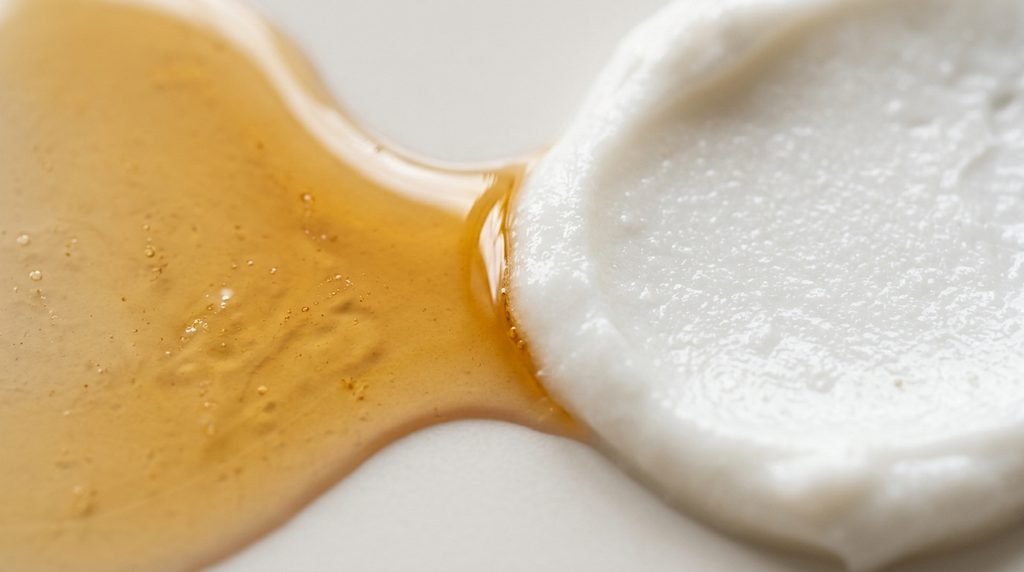
| Criterion | Route A — Actives-Led | Route B — Barrier-Led |
|---|---|---|
| Built around | Retinol, retinal, prescription retinoids | Peptides, niacinamide, ceramides, squalane |
| Depth of evidence | Deepest available for topical skincare | Genuine but younger and less unified |
| First visible change | Around 8–12 weeks | 3–5 weeks, starting with plumpness |
| Type of change | Structural over time | Supportive and cumulative |
| Irritation risk | Moderate, occasionally high | Minimal |
| Adjustment period | Yes, expect a rough few weeks | None |
| Suits menopausal dryness | Only with careful buffering | By design |
| Pregnancy / nursing | Avoid | Suitable |
| Rough monthly cost | $10–$60 | $15–$70 |
| How it usually fails | Overuse wrecks the barrier | Too gentle for too long, no progress |
Both routes genuinely work. They fail in opposite directions — which is precisely why picking the wrong one for your skin costs you a year.
How strong is the evidence, really
Retinoids are the closest thing skincare has to a settled answer. They are vitamin A derivatives, they have been studied for decades, and they act on the deeper layer of skin rather than polishing the surface. Prescription strengths do more than over-the-counter ones; retinal sits between the two. If you want the option with the most convincing history behind it, that is the one.
Peptides are short chains of amino acids that act as messengers, nudging skin toward repair and firmness. The category is real, but it is not one ingredient — it is dozens, each behaving differently, and much of the published work is small in scale. That doesn’t make peptides useless. It makes broad claims about “peptides” as a group unreliable.
Verdict: Route A wins on evidence. That does not mean it wins for you — see Criterion 3.
Widely available examples: drugstore retinol creams from mass brands, mid-strength retinal serums from ingredient-focused labels, and prescription options through a doctor where regulations allow.
How fast you will actually see change
Route B feels productive sooner. Hydration improves within a few weeks, and hydrated skin reflects light better, so the mirror rewards you early. Route A does the opposite — it usually looks worse before it looks better, with a stretch of dryness, flaking and sometimes small breakouts before the improvement arrives.
Decide your timeline before you buy, not after. Anything judged at week three has not been judged at all. Fine lines and firmness are twelve-week questions. Texture and tone are six-week questions. Hydration is a two-week question.
Tolerance, and why midlife skin changes the maths
This is where Route B earns its place. Skin in the perimenopausal years is thinner, drier and slower to recover than the skin most retinol instructions were written for. A strength a twenty-nine-year-old uses nightly without complaint can strip a forty-seven-year-old’s barrier within a fortnight, and a damaged barrier undoes months of progress.
If you want Route A anyway — and plenty of women should — two adjustments keep it survivable:
- Buffer it. Moisturiser first, retinoid on top, for the first four to six weeks.
- Alternate it. Retinoid on two or three nights, peptide serum on the rest.
That second approach is, in practice, where most women over forty end up after a year of trial and error. It captures most of the benefit of the stronger route while keeping the skin comfortable enough to stay consistent, and consistency is the variable that actually decides the outcome.
Hydration and barrier repair for dry skin over 40
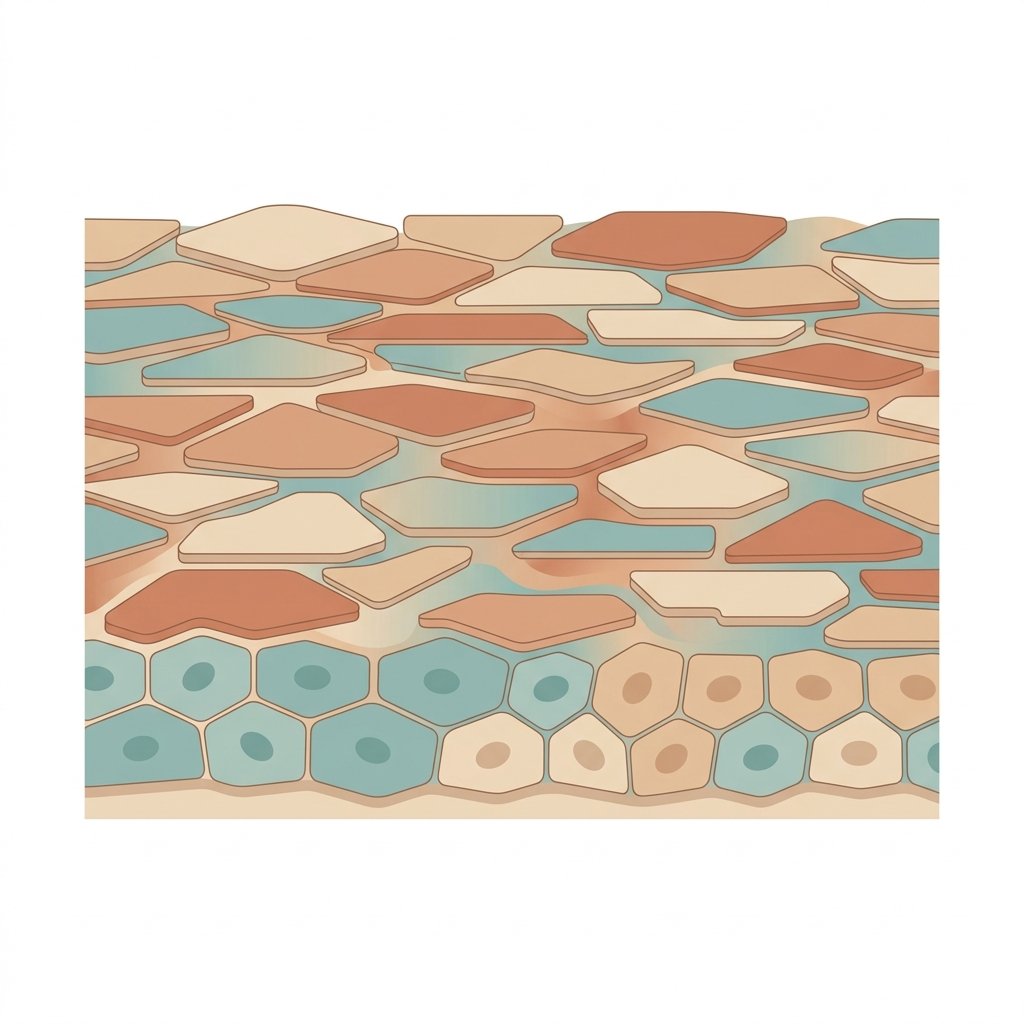
Neither route works without this, so treat it as shared foundation rather than a step you can skip when you’re tired.
The skin’s outer layer holds water in via a mix of lipids — ceramides, cholesterol, fatty acids. Production of those drops with age, which is why moisturisers that were adequate at thirty feel like nothing at forty-five. Look for a formula that includes ceramides or plant lipids alongside a humectant, and a texture heavy enough that your skin still feels comfortable six hours later.
A practical rule: when a dry patch and a spot appear side by side — a very forties combination — repair the barrier first and treat the spot second. Every active you own performs better on intact skin.
Climate matters here more than brand. In humid tropical regions a gel-cream is often enough year-round. In dry continental winters or heated indoor air, the same person may need an occlusive balm at night. The right moisturiser in Manila is not the right moisturiser in Warsaw.
Tone, pigmentation and uneven patches
Blotchiness and dark marks are usually what sends someone shopping in the first place, and most of that pigmentation is cumulative sun exposure rather than age itself.
- Route A works on it directly, by speeding the turnover of pigmented cells. Slow, steady, dependable.
- Route B works on it indirectly, mainly through niacinamide and better barrier function. Gentler, less dramatic.
- Vitamin C belongs to either route, used in the morning, kept separate from a nighttime retinoid.
One point that region-specific advice often misses: richer skin tones pigment more readily in response to irritation. If your skin marks easily after a spot or a scratch, an aggressive actives routine can create the exact discolouration you were trying to treat. That argues strongly for the slower route and for lower strengths held for longer.
Sun protection — the step that decides everything else
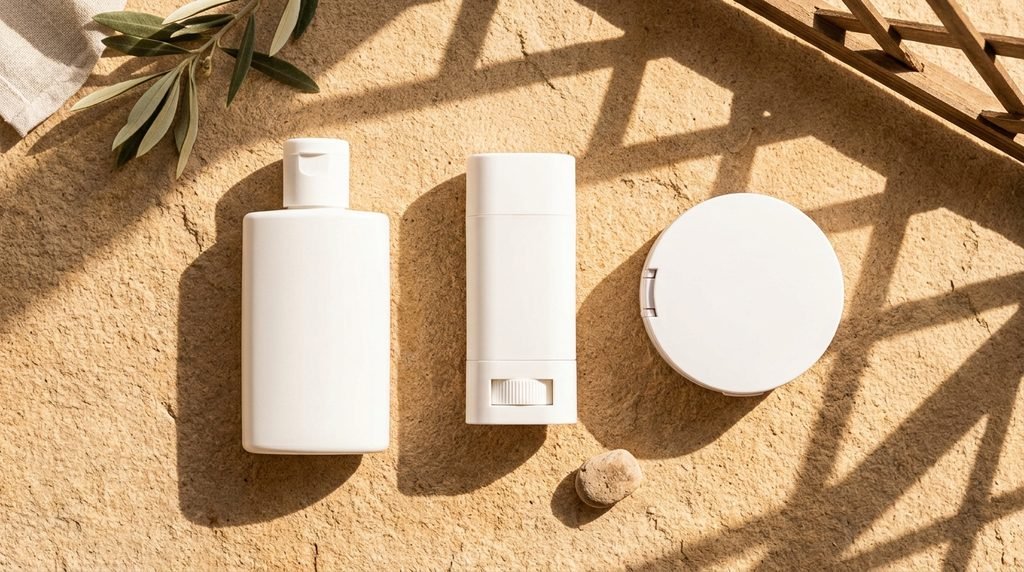
If you take one thing from this comparison, take this. Ultraviolet exposure degrades the collagen and elastin that every serum on the shelf is trying to rebuild. Running an expensive active routine without daily sun protection is paying to fill a bucket with a hole in it.
Broad-spectrum, applied every morning, reapplied when you are outdoors for long stretches. That is the whole instruction.
Two global realities worth knowing:
- Filter availability differs by country. Several elegant, high-performing UV filters are widely sold across Asia, Europe and Australia but not approved in every market. If the sunscreens available to you feel heavy or leave a cast, that is a regulatory issue in your region, not a personal failing.
- UV load varies enormously. Equatorial and high-altitude readers face intense year-round exposure; readers at high latitudes face a strong summer and a weak winter but heavy indoor glass exposure regardless.
Retinoids also make skin more light-sensitive, so on Route A sunscreen stops being advice and becomes part of the protocol.
Cost and availability, honestly
| Tier | Rough monthly cost | What it buys |
|---|---|---|
| Essential | $20–$40 | Sunscreen, ceramide moisturiser, basic retinol. Delivers the large majority of achievable results. |
| Considered | $55–$110 | Adds a well-formulated peptide or vitamin C serum, better textures, gentler delivery |
| Premium | $150+ | Elegance, packaging, sensory experience, modest formulation gains |
Price and outcome are only loosely related. A modest retinol used four nights a week outperforms a luxury serum used when you remember. Where price does buy something real is tolerability — better-formulated actives tend to irritate less, and a product you can actually keep using is worth paying for.
Availability is the other half of this. Import duties, limited distribution and grey-market pricing mean a “budget” product in one country can be a luxury purchase in another. Buy the ingredient category locally rather than chasing a specific brand across borders.
Safety, and when to stop
Default to Route B, and skip retinoids entirely, if you are pregnant or breastfeeding, currently managing rosacea or eczema, or have reacted badly to retinol before.
Stop and reassess if you get persistent burning, swelling, or a rash that spreads — that is not an adjustment phase. And treat any of the following as a medical question rather than a shopping question: a mole that changes shape or colour, a sore that doesn’t heal, or pigmentation that hasn’t shifted at all after several consistent months. A dermatologist visit is the highest-value spend available to anyone over forty, and no serum substitutes for it.
Which should you choose?
If your skin is robust and rarely stings: Route A. Begin at a low strength, twice weekly, buffered, and hold your nerve for twelve weeks.
If your skin has turned tight, flushed or newly reactive: Route B for three months to rebuild comfort, then introduce a gentle retinoid twice a week.
If pigmentation is your main concern: Route A at night, vitamin C in the morning, sun protection without exceptions.
If you pigment easily after any irritation: Route B, low and slow, with patience rather than strength.
If you are pregnant, nursing or rosacea-prone: Route B only.
If you already own twenty products and see no results: cut back to three — sunscreen, moisturiser, one active — and add nothing for two months.
If you want the honest best answer: the hybrid. Retinoid two or three nights, peptide serum on the others, a proper moisturiser every night, sun protection every morning. It captures most of Route A’s payoff at most of Route B’s comfort level.
Also Read: Best Luxury Handbags Worth the Investment in 2026
Your next steps
- Empty the shelf tonight. Anything that stings, and anything opened more than a year ago, goes.
- Buy the foundation before the treatment — sunscreen and a lipid-rich moisturiser first.
- Choose one route from the section above and stay on it for twelve weeks without additions.
- Take a photograph on day one, in daylight, no makeup. Memory is not a reliable control.
- Introduce new products one at a time, four weeks apart, so you can tell what did what.
- Adjust for your climate each season rather than buying a new routine each season.
- Book a skin check if anything is changing, itching or bleeding.
Results after forty come from a small routine kept up for a long time. Nobody markets that, because there is nothing in it to sell.
FAQ
Does mature skin really need a separate eye cream?
Often not. Most eye creams are lighter, milder versions of face formulas, built for thinner skin that irritates easily. If your face moisturiser is comfortable close to the eye area, it can do the job. An eye product earns its place when you want a gentler retinoid strength there, or when puffiness and crepiness are your specific complaint.
Can retinol and vitamin C be used in the same routine?
Yes, but at opposite ends of the day — vitamin C in the morning, retinoid at night. Used together in one sitting they raise the chance of irritation without adding benefit. Separating them costs nothing and removes the risk.
Is expensive skincare actually better after 40?
Not reliably. Higher prices usually buy texture, fragrance, packaging and sometimes gentler delivery systems rather than different active ingredients. The exception is tolerability: a better-formulated active you can keep using beats a cheaper one you abandon.
How long should I give a new product before deciding?
Two to three months for anything targeting lines or firmness. Two to three weeks for hydration. If you are switching products monthly, you are running an experiment with no result.
My skin is peeling on retinol — should I stop?
Reduce first. Drop to every third night, apply moisturiser underneath, and rebuild slowly once things settle. Only stop outright if there is persistent burning, swelling or a spreading rash.
Does the right routine change depending on where I live?
Yes, more than most guides admit. Humidity, UV intensity, indoor heating and which sunscreen filters are sold in your country all change what works. The three-part framework holds everywhere; the textures and strengths should be local.
If I could only buy one product, what should it be?
Sunscreen. It protects the collagen every other product is trying to rebuild, and no serum can compensate for skipping it.
1 thought on “Best Skincare Products for Women Over 40: What Works”
Comments are closed.