
How to Start a Clothing Brand in 2026: A Complete Global Launch Blueprint
What a clothing brand actually is
A clothing brand is not a folder of designs. It is a business that owns a protected name, a list of people who trust it, and a relationship with someone who can make things.
Hold on to that distinction, because it quietly settles most of the arguments new founders have with themselves.
A clothing line is a group of garments produced for a season. A clothing brand is the durable structure underneath — the registered mark, the audience, the supplier who answers your messages, the customer who orders again without needing to be persuaded a second time.
The practical consequence is about where you spend. Money that goes into the name, the customer list and the supplier relationship compounds. Money that goes into more styles usually does not. Founders who invert that ratio spend year one producing and year two wondering why nobody remembered them.
How the independent clothing brand got here
Two forces shaped this category in opposite directions: production got radically easier, and attention got radically more expensive.
For most of the last decade the barrier to entry collapsed. On-demand printing removed inventory risk almost entirely — upload artwork, and a garment is produced only after somebody has already paid for it. Marketplaces and social platforms handed out reach for free to anyone willing to post consistently. Small factories in a dozen countries started quoting minimums that a single person could afford.
Something less convenient happened alongside it. Every one of those advantages became available to everyone at the same time, which is another way of saying it stopped being an advantage. Feeds filled with lookalike labels selling lookalike blanks. Organic reach on the big platforms tightened. Cross-border shipping and import rules in several major markets grew stricter and more expensive rather than looser.
So the entry point is cheaper than it has ever been, and the middle of the journey is harder than it used to be. That is not a reason to avoid starting. It is a reason to start with a plan for demand rather than a plan for product.
Where things stand in 2026
Consumers are cautious, differentiation is scarce, and small deliberate brands are better positioned than mid-sized undifferentiated ones.
Three conditions define the current landscape, and they hold across most markets rather than just one.
Shoppers are more price-aware than they were, which does not mean they only want cheap things. It means they want the reason for the price to be visible. A garment that clearly justifies what it costs — through fabric, fit, construction or a point of view — sells more easily than one sitting in the undefined middle.
Trade and shipping costs have become genuinely unpredictable in several regions. Duty rates, low-value parcel exemptions and customs procedures have all shifted in recent years, and the direction of travel has generally been toward more paperwork and more cost, not less. Whatever your country, treat your import assumptions as something to re-check before every purchase order rather than something you learn once.
Meanwhile, overproduction has moved from a private embarrassment to a public and increasingly regulated one. Unsold stock is expensive, it is becoming harder to quietly dispose of, and in a growing number of jurisdictions it carries reporting or take-back obligations. Produce less than you think you need. [internal link: small-batch production planning]
The eight components you have to build
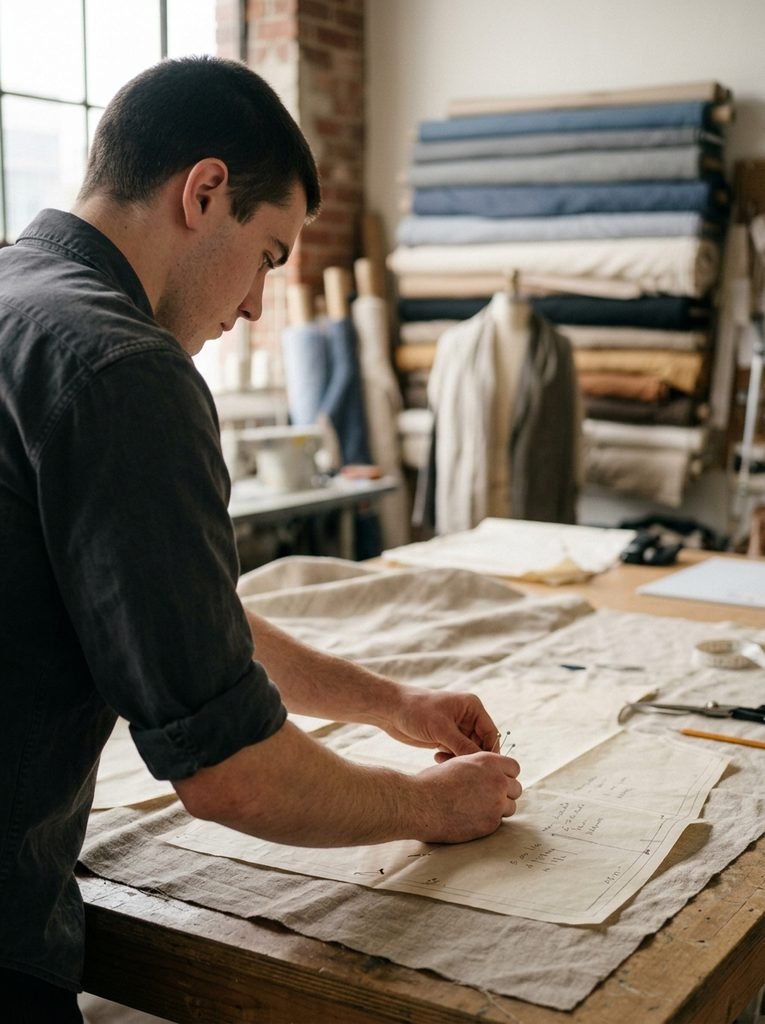
Every working clothing brand contains the same eight parts. Skipping one does not slow you down — it stops you at an inconvenient moment.
1. A customer definition narrow enough to feel risky
“People who like streetwear” is not a customer. “Cyclists who commute in city clothes and want a jacket that does not look like sportswear” is one. The narrow version tells you fabric weight, price ceiling, size range, colour palette and — most usefully — exactly where to find your first hundred buyers without paying for them.
Nearly every founder resists narrowing, because narrowing feels like shrinking the market. It is the opposite. You cannot be discovered until you are describable.
2. The legal entity and how to trademark a clothing brand
Structures differ by country, but the trigger points are the same everywhere. You want a registered entity by the time you are holding stock, signing supplier contracts, or importing goods under your own name, because those are the moments where liability stops being theoretical.
The trademark deserves more attention than most founders give it. Apparel is one of the most crowded registers in every jurisdiction, and rebranding in year two — new labels, new packaging, new domain, lost search history — costs vastly more than filing did. Almost all national systems classify clothing under the same international class number, and most treat online retail services as a separate class with a separate fee. Registration typically takes several months to a year, so start it before the name is stitched into anything.
Two habits worth building: search the register before you fall in love with a name, and check whether the mark is free in the markets you plan to sell into, not just the one you live in. [internal link: naming and trademark checklist]
3. The product and its tech pack
A tech pack is the document a factory can actually work from. At minimum it carries a technical drawing, every point of measure graded across your size range, fabric specification including weight, trims and hardware, stitch and seam types, print or embroidery placement with dimensions, label positions, and packing instructions.
Without one you are describing a garment. With one you are ordering it. The difference shows up in your sample rounds, and sample rounds are where new brands lose months.
4. The production partner and realistic minimums
There are three routes, and the honest way to choose is by what your capital can absorb.
On-demand printing carries no inventory and thin margins, which makes it a testing tool rather than a business model. Blank apparel — buying quality unbranded garments and adding your own labels, decoration and packaging — is where most serious independents genuinely belong at launch, because it gives you brand control without inventory suicide. Full custom production, where the garment is developed from pattern up, is the endpoint rather than the entry.
Minimums vary enormously by country and factory. As a working expectation: decorating existing blanks may need only dozens of units, small private-label workshops often start in the low hundreds per style, and full cut-and-sew production frequently asks for several hundred pieces per style before a factory finds the job worth scheduling. Get quotes from at least three suppliers, and order samples from all three before choosing. A specification sheet will never tell you how a collar behaves after four washes.
5. Garment labelling requirements you cannot skip
This is the component most first-time founders discover late, usually when a shipment is already sitting somewhere it should not be.
Most consumer markets require broadly the same four disclosures on a garment: what it is made of, where it was made, who is responsible for putting it on the market, and how to care for it. The exact wording rules, language requirements, symbol standards and label permanence rules differ by jurisdiction — and if you sell across borders, you may need to satisfy several sets at once.
Two practical rules. Build the labelling into your very first production run rather than retrofitting it, because reworking labels on finished stock costs more than specifying them correctly once. And check the requirements of every market you intend to ship to, not only the one you manufacture in. Your national consumer-protection or trading-standards authority publishes this material, and it is worth an afternoon.
6. Pricing, margin and clothing brand startup costs
Your cost is not the price on the supplier’s quote. It is that number plus import duty, freight, customs handling, decoration, labels, packaging, payment processing and an allowance for returns. Founders who price off the quote and not the landed figure discover the problem at exactly the point when it is hardest to fix.
A workable rule of thumb: aim for a retail price at least two and a half to three times your fully landed unit cost. That sounds greedy until you subtract shipping, transaction fees, returns and the cost of finding the customer — at which point it starts to look like survival.
The other number to sit with is what it costs to acquire a buyer. For low-priced single items sold through paid advertising, acquisition cost can easily exceed the entire gross margin on the order. If it does, paid traffic will not save the business. Only organic reach, higher basket value or repeat purchase will.
7. The storefront and sales channel
You have three broad options and no obligation to pick only one: a marketplace, a social commerce channel, or your own hosted store.
Marketplaces and social platforms give you traffic you would otherwise buy, which matters enormously in month one. Your own store gives you margin, data and a customer list, which matters enormously in year two. The sensible sequence for most founders is to validate where the buyers already are, then migrate the relationship onto ground you own.
Whichever you pick, publish real garment measurements rather than only size letters. It is the single cheapest thing you can do to protect your margin.
8. Demand
The one component that cannot be bought, outsourced or automated.
Presell. Run a waitlist. Sell a small sample run at close to cost to fifty people and then actually listen to what they say about fit, fabric and price. Every expensive failure in this category looks identical from the outside: boxes of stock bought on the strength of a founder’s confidence rather than a customer’s money.
What usually goes wrong

Three failure modes account for most of it, and all three are financial decisions wearing creative clothing.
Producing before validating. The most common and the most expensive. Capital converted into unwanted inventory cannot be converted back, and no amount of marketing spend afterwards fixes a product nobody asked for.
Underestimating returns. Clothing is structurally the most returned category in online retail, because it is the only thing people buy unseen that has to fit one specific body. Fit and sizing drive the overwhelming majority of it, and each return costs you outbound shipping, return shipping, handling time and often the resale value of the item. Model a realistic return rate into your pricing from day one. Detailed measurement charts and honest fit notes are cheaper than reverse logistics.
Confusing activity with traction. Posting daily, redesigning the logo, expanding the range. None of that is demand. Repeat purchase rate is demand. Everything else is preparation.
Outlook: how to start a clothing brand that lasts beyond year two
The labels that survive will be the ones that stayed deliberately small for longer than felt comfortable.
Every pressure currently acting on this industry punishes the same thing: capital trapped in stock. Slow consumer spending punishes it. Unpredictable import costs punish it. Tightening rules around unsold inventory punish it. The strategic response is not clever marketing — it is restraint.
That points a new brand toward a specific operating pattern. Fewer styles, produced deeper on the ones that actually sell. Reorders funded by sell-through rather than optimism. A size curve built from real order data instead of an even spread across the range. Pricing with enough headroom to absorb a shipping or duty change without a crisis.
The genuine upside is that a small, sharply defined brand no longer needs a wholesale account, a showroom or a press contact to reach anybody. The distribution is open. What is scarce is the point of view.
Key takeaways
- The brand is the name and the customer list. Garments are the output, not the asset.
- Register the trademark early, in every market you plan to sell into — it is cheap now and brutal later.
- Labelling is law, not decoration. Composition, origin, responsible party and care instructions, in your market’s required form.
- Price off landed cost, not the supplier quote — and target roughly 2.5–3× as a floor.
- Clothing returns more than any other category. Publish real measurements and budget for it.
- Validate before you produce. Every other mistake here is survivable. Unsold stock often isn’t.
Also Read: Scarf Top Outfit: Turn a Scarf Into a Chic Top
The bottom line
Starting a clothing brand in 2026 costs less at the entry point than at any time in the industry’s history and punishes overreach more severely than it used to, which makes deliberate smallness the winning strategy rather than a compromise. Put the boring foundations — entity, trademark, labelling, landed-cost pricing — in place at the beginning, because each of them is inexpensive now and painful to retrofit. Then treat the first reorder, not the launch, as the moment worth celebrating.
FAQ
Does it matter which country I start a clothing brand in?
Less than people assume for product and marketing, more than people assume for logistics. Your customer definition, design and storytelling travel freely. Your import duty, tax registration, labelling rules and shipping economics do not. Pick your primary selling market early, because it determines the compliance work and the freight maths.
How much money do I actually need to start?
Enough to make a small run properly and still afford the second one. A print-on-demand test can start with the cost of samples. A real branded first run — blanks, decoration, labels, packaging, photography — typically needs low four figures in most currencies. Whatever the number, hold back roughly a third of it for the reorder of whatever sells out.
Can I run a clothing brand without any design or sewing skills?
Yes, and many good ones are. What cannot be outsourced is knowing precisely who you are dressing and why they should care. Pattern making, illustration and garment construction can all be bought. Taste and audience understanding cannot.
Should I launch with one product or a full collection?
One product, done well, in two or three colourways. A full collection multiplies your inventory risk, splits your photography budget and gives you muddier data about what people actually want. Range is a reward for a proven bestseller, not an opening move.
How do I find a manufacturer I can trust?
Ask for samples before discussing volume, ask for references from brands at your size rather than their largest client, and place a deliberately small first order even if a bigger one is cheaper per unit. A supplier’s behaviour on a small job tells you what they will be like on a large one.
How long before a clothing brand becomes profitable?
Plan for a year to eighteen months of reinvesting everything, and treat anything quicker as good fortune. Cash flow usually turns positive before profit does, because your first reorder is funded by your first sell-through rather than by new capital.
1 thought on “How to Start a Clothing Brand: A Global Launch Blueprint”
Comments are closed.